

It took almost six months—and roughly 1,600 hot glue sticks—for a group of Arizona students to recreate one of the largest computers ever built, a machine originally designed for the US Army and unveiled in 1946.
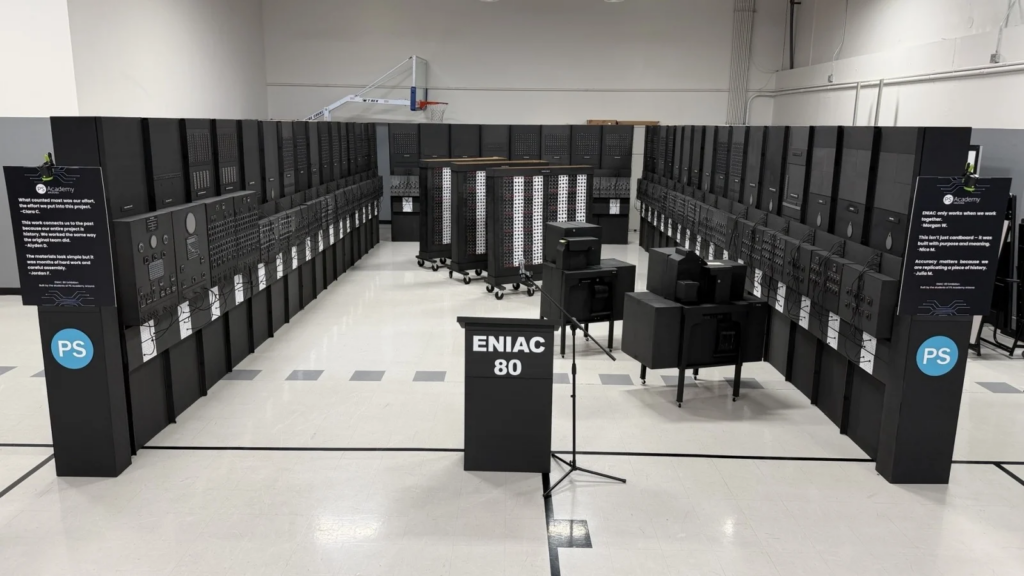
Early computers were so enormous they filled entire rooms, a stark contrast to today’s pocket-sized smartphones. One of the most famous of these machines was the Electronic Numerical Integrator and Computer, better known as ENIAC. Introduced in 1946, ENIAC occupied about 1,800 square feet, weighed more than 30 tons, and remained in constant operation until it was taken apart in 1955.
Nearly 80 years later, ENIAC has been brought back to life—at least visually—by 80 autistic students at PS Academy Arizona in Gilbert. Most of the students were between 12 and 16 years old. Their ambitious project involved fabricating 22,000 custom pieces and assembling them using 1,600 hot glue gun sticks. From the first day of school in August 2025 to a public unveiling ceremony held on Thursday, January 15, the build took a total of five and a half months.
While the replica does not actually function as a computer, it gives visitors a powerful sense of ENIAC’s true scale. The installation is fully illuminated with hundreds of LEDs and includes an audio soundtrack that mimics the low hum of transformers and the clicking of relays, according to Tom Burick, the technology teacher who guided the project.
Originally, the US Army used ENIAC to speed up the calculation of artillery firing tables—a task that had previously required teams of human computers working for long periods of time. Over time, the machine was reprogrammed to handle other complex tasks, including nuclear feasibility studies and early weather modeling.
Whether ENIAC was truly the first computer ever built depends on how one defines the term. “You have to be careful with computer people,” Burick jokes. He notes that earlier machines did exist, but they were limited to performing only one specific task. ENIAC, by contrast, was far more advanced and closer in concept to modern computers.
“ENIAC is widely recognized as the world’s first general-purpose electronic computer,” Burick explains. “It’s the direct ancestor of every computer we use today because it was fully electronic and could be reprogrammed to solve many different problems.” That historical importance is why he teaches ENIAC in his computing history lessons each year—and why, this time, he chose to make the lesson tangible.
Leave a Reply